
Blog
Urban Survival Skills Everyone Should Know: Practical Preparedness for City and Suburban Living

Survival skills are most commonly discussed in wilderness contexts: navigation by stars, building debris shelters, finding water in the backcountry. These skills matter in the specific scenarios where they apply. But the statistical reality is that most emergency events in the United States affect people living in urban and suburban environments, where the threats are not hypothermia and dehydration in a forest but infrastructure failure in a city, civil unrest in a neighborhood, or the need to evacuate a densely populated area where every road is shared by thousands of people making the same decision at the same time.
Urban survival skills are different in character from wilderness skills, though the underlying principles overlap. This guide covers the most practical capabilities for the urban and suburban resident who wants genuine preparedness rather than a gear collection.
Situational Awareness
Situational awareness is the foundational skill for urban safety and the one that costs nothing and requires no equipment. It means understanding your environment well enough to recognize what is normal and notice what is not, identifying exits and potential threats in any space you enter, and maintaining the attentional bandwidth to process that information continuously rather than narrowing focus to your phone screen.
The OODA loop (Observe, Orient, Decide, Act) developed by military strategist John Boyd describes the cognitive process that underlies effective response to threat. The critical insight is that speed through the loop, particularly at the Observe and Orient stages, is what allows rapid effective response. People with high situational awareness orient faster because they have already built a baseline model of their environment and can detect deviations quickly.
Practice: when you enter any building, identify the exits before you sit down. When you park, note what is around you. When something feels wrong, trust that feeling enough to change your behavior. These habits cost nothing and produce measurable safety improvements.
Urban Navigation Without Technology
GPS-dependent navigation is a significant urban preparedness vulnerability. Cell networks fail during disasters. Phone batteries die. GPS signal can be disrupted or spoofed. The person who can navigate using a paper map, compass, and landmark knowledge is not dependent on any of this infrastructure.
Obtain physical maps of your city, your county, and your likely evacuation routes. Learn to use a compass and orient a map to your actual position. Know the cardinal directions relative to your home, your workplace, and your neighborhood. Understand the grid or network structure of your city well enough that you could navigate from major landmarks without turn-by-turn guidance.
Water and Food Security in an Urban Context
Urban water supply depends on powered pumping stations and treatment infrastructure that fails during extended power outages. Knowing how to access and treat water when municipal supply is disrupted is a critical urban survival skill. Store a minimum of one gallon per person per day for at least two weeks. Know how to shut off your home water supply at the main valve to prevent contamination from backflow during infrastructure failure. Know how to treat water from urban sources, including swimming pools and water heaters, using filtration and chemical treatment.
Urban food security during a disruption depends on stored supply and knowledge of neighborhood resources. Most urban areas have community gardens, public fruit trees, and other food sources that are not visible to people who have not specifically looked for them. Knowing your local food landscape is a meaningful preparedness asset even if you never need to use it.
Evacuation Readiness from an Urban Environment
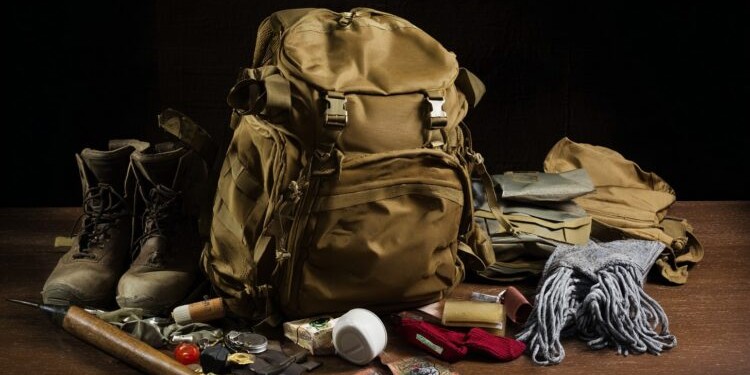
Urban evacuation presents specific challenges that rural evacuation does not: dense traffic, high population competing for the same routes and resources, multistory buildings that require stairwell navigation if elevators fail, and limited options for on-foot movement when vehicles become gridlocked. Every urban resident who takes preparedness seriously should have a fully equipped bug out bag that can support them for at least 72 hours of independent movement, whether that means traveling on foot across the city to reach a designated meeting point, navigating out of the urban area entirely, or sustaining themselves during a shelter-in-place period without external resupply.
Urban packs have different requirements than wilderness packs. Cash in small denominations matters in cities in ways it does not in wilderness. Personal protection considerations are different. Documentation and communication tools take higher priority. A multi-tool and duct tape solve different problems than a fire starter and emergency bivy, though both have their place.
Shelter in Place vs. Evacuation Decision-Making
One of the most important urban survival skills is knowing when to stay and when to go. Evacuating too early wastes resources and may put you on the road during a deteriorating situation unnecessarily. Evacuating too late may mean leaving into conditions worse than what you face by staying. The decision framework depends on the threat type, your specific location relative to the threat, your household’s capabilities, and the state of the external environment.
General principles: chemical or radiological threats typically require immediate evacuation upwind of the source or shelter in place with sealed ventilation, depending on proximity. Flood threats in low-lying areas require early evacuation before roads become impassable. Structural fire threats require immediate building evacuation. Civil unrest threats depend on location, trajectory of the situation, and your specific exposure. Building these decision frameworks in advance, rather than improvising under stress, is what allows fast, correct choices when conditions are deteriorating.
Power Outage Preparedness
Extended power outages are the most common urban emergency event and the one most households are least prepared for. Modern urban life is deeply electricity-dependent: water pumps, heating and cooling, refrigeration, communication, lighting, and medical equipment all require power. A household that can function independently for two weeks without grid electricity has resolved the vast majority of its urban emergency exposure.
Key components: battery bank and solar charging capability for communication devices. Alternative lighting through LED lanterns and headlamps with adequate battery supply. Alternative cooking through a propane camp stove with stored fuel, or a wood burning option if your location permits. Thermal management through appropriate sleeping bags and layering rather than electrical heating or cooling. Generator capacity for households with medical equipment that cannot be battery-backed.
Community as a Survival Asset
Individual preparedness has real limits. A household that knows its neighbors, has relationships built before an emergency, and can coordinate with surrounding households during a crisis has capabilities that no amount of individual gear can replicate. Neighbor networks provide redundant labor for tasks requiring more than one person. They provide shared resources that no individual can stockpile completely. They provide the social infrastructure that determines whether a neighborhood deteriorates or coheres under stress.
The most prepared urban survivalist who is unknown to all their neighbors is less resilient than a moderately prepared household embedded in a connected neighborhood community. Building those connections is a preparedness investment as real as any gear purchase.